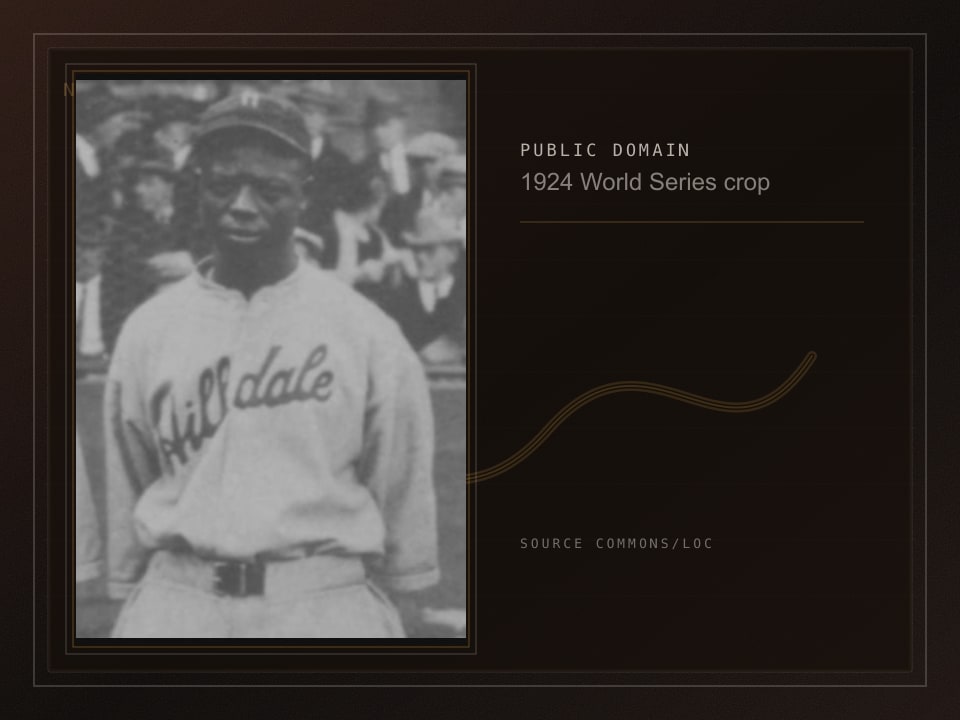
Phil Cockrell, 1924
Cockrell's plate stays deliberately thin: a surviving likeness beside a record that names the pitch but not the grip.
Small source crop at 230 by 329 pixels, held inside a matte.
Open Phil Cockrell's SpitballNegro Leagues / 1918-1932
A moist-ball artist, and the day the leagues' divergence stood on the field
Documented
Cockrell was a 'moist ball' artist — a controlled spitballer, not a slobberer — with uncanny command and a stack of no-hitters across fifteen years for Hilldale. His pitch is the cleanest illustration of the two-rulebook world: in the 1924 Colored World Series, a white umpire from the International League stopped play to enforce the spitball ban, and the dispute was only settled when Hilldale's side appealed to commissioner Rube Foster, who told them to let him keep throwing it.

Phil Cockrell, 1924
Cockrell's plate stays deliberately thin: a surviving likeness beside a record that names the pitch but not the grip.
Small source crop at 230 by 329 pixels, held inside a matte.
Open Phil Cockrell's SpitballA controlled 'moist ball' spitball — lightly dampened rather than heavily loaded — thrown with uncanny command, the foundation of a fifteen-year Hilldale career studded with no-hitters.
The spitball was banned in the white majors after 1919, but the Negro National and Eastern Colored Leagues never adopted the ban — so Cockrell's whole craft was legal in his game and outlawed in the other, leaving it no path forward when the leagues finally merged.
In Game One of the 1924 Colored World Series, on a 1-and-2 count to the Monarchs' Lem Hawkins, Cockrell's spitball prompted a white International League umpire to stop play to enforce the ban; Hilldale's Ed Bolden appealed to NNL commissioner Rube Foster to let the game continue without prohibiting the pitch, and Foster agreed.
SABR records the intervention as Ed Bolden appealing to Foster, who agreed — not Foster physically halting play on the field; framed to match the bio.
Cockrell is credited with about six no-hitters over his career, including performances against the Detroit Stars and the Chicago American Giants.
Every line here is what the recovered record can actually support, labeled by its source and its confidence. Where the legend says more than the record can prove, the gap is shown, not filled.