Photo-supported grip cue
Two-finger fastball family grip with the fingertips crossing the seam path instead of riding inside two parallel seams.
Archive file · Specimen No. 00
The pitch you trust for a strike. It takes the truest line and gives the hand the cleanest exit.
Open this like an archive drawer: grip first, source attached, shape in words, no invented spin or movement numbers. The file exists so the hold can keep moving forward.
Rides
Rides through the top of the zone. Backspin fights the fall the whole way, so it drops less than a spinless ball and looks like it holds its line. It carries; it never literally rises.
ShapeReputable analysisIndex and middle fingers laid across the seams at the open end of the horseshoe, the seam that faces away from the body. Thumb underneath on the leather. Held loose toward the fingertips.
Archive Drawer / Grip Lab
Lead with the hand. The fingers on the ball below are the sourced contacts, solved onto the seam. Drag the ball, or use the view buttons.
View
Hand
Keyboard: arrows switch views · F flips the hand · H lifts it
What it should feel like
Least resistance. Loose in the fingertips, shallow in the hand. Let it sling cleanly off the pads.
Grip geometry is schematic, tuned from sourced grip descriptions and private visual reference, not measured from an athlete scan. In a live photo, the tell is two fingertips crossing a seam path, not riding parallel seam tracks.
Ball depth
Out in the fingers
Spacing
Slight spread
Index and middle fingers laid across the seams at the open end of the horseshoe, the seam that faces away from the body. Thumb underneath on the leather. Held loose toward the fingertips.
Paraphrased from the cited reference, not quoted. Corroborated by Wikipedia (Fastball) and eFastball.
Fingers cross the outward-facing horseshoe seam, pads resting where the two seams run closest together.
Wikipedia (Four-seam fastball) and (Fastball) agree: across the cross-seam that faces away from the body. eFastball corroborates.
Roughly a finger-width apart. Secondary instruction puts the gap near half an inch to an inch.
The weakest grip claim. Primary references prescribe no numeric gap, and Driveline treats spacing as athlete preference, from pressed-together to widened.
Thumb directly underneath the ball on smooth leather, its base sometimes overlaying a lower seam, centered between the two top fingers.
Strongly corroborated across Wikipedia (Four-seam fastball), Wikipedia (Fastball), and eFastball.
Held loosely toward the fingertips with a gap to the palm, the usual cue for a quick, clean release. Not universal.
Surfaced disagreement: eFastball also says to squeeze, and Driveline declines to prescribe pressure at all. Shown as the standard cue, not an absolute.
Grip Evidence
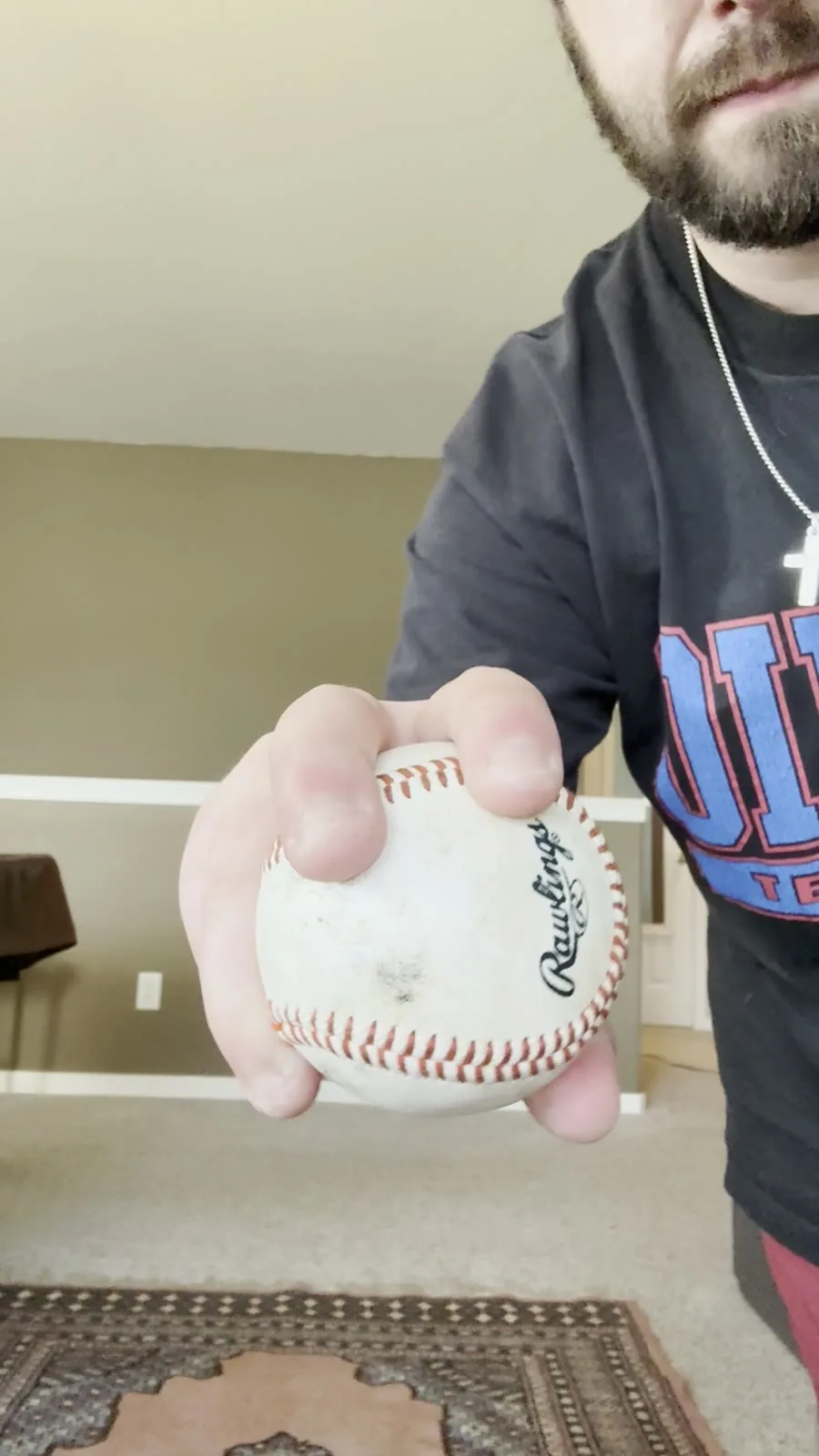
This is the visual grip-reference layer for Four-seam fastball. It names visible placement and Austin's own feel notes, then stops before making measured claims.
A looping close-up of Austin's four-seam grip: two fingertips laid across the seam, the ball held out toward the camera.
Original · Austin H.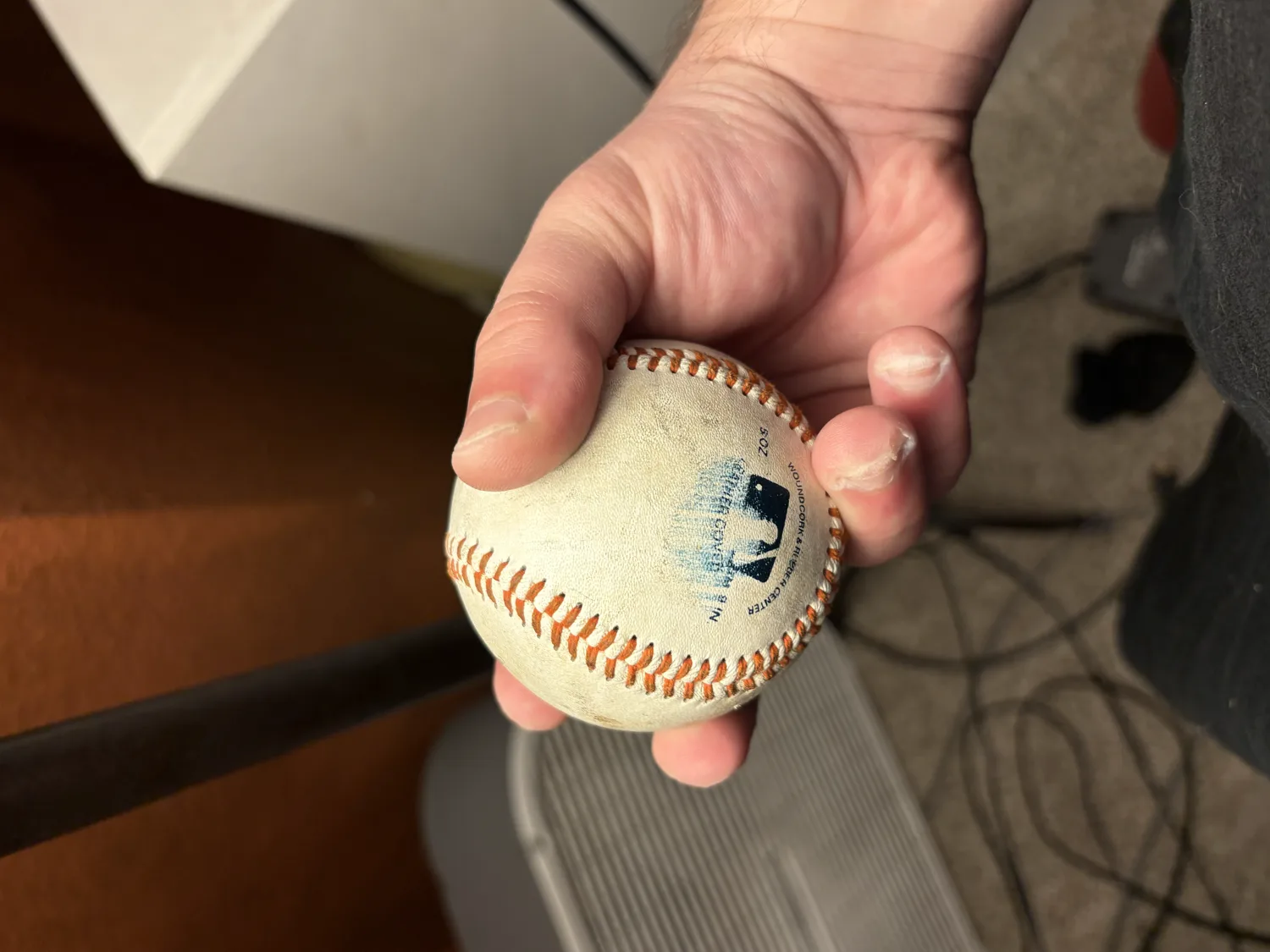 Top
TopTop of the grip: index and middle fingertips laid across the seam at the wide horseshoe, thumb tucked underneath.
Original · Austin H. · 2026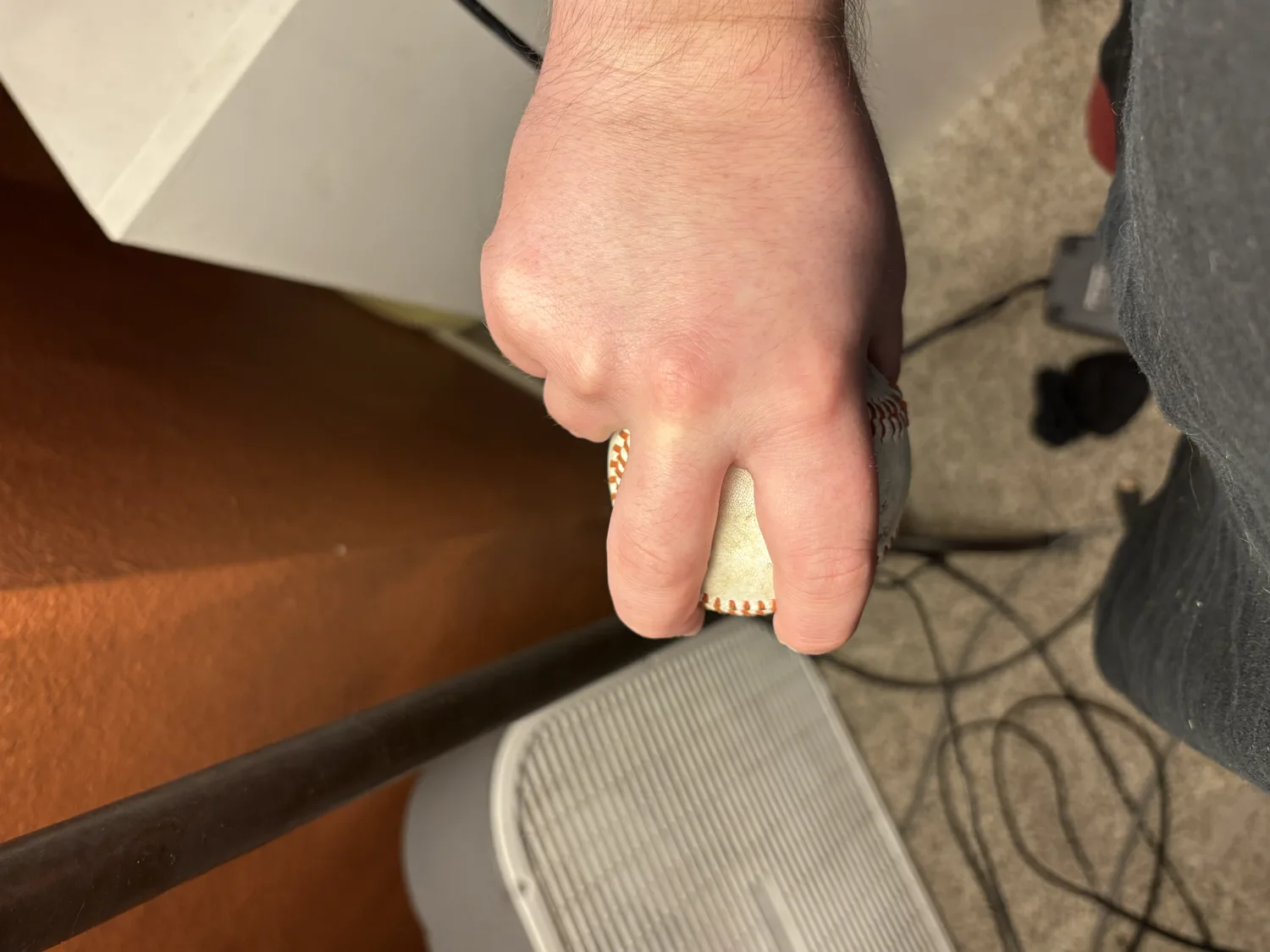 Underside
From underneath: the thumb on smooth leather, centered below the two top fingers.
Original · Austin H. · 2026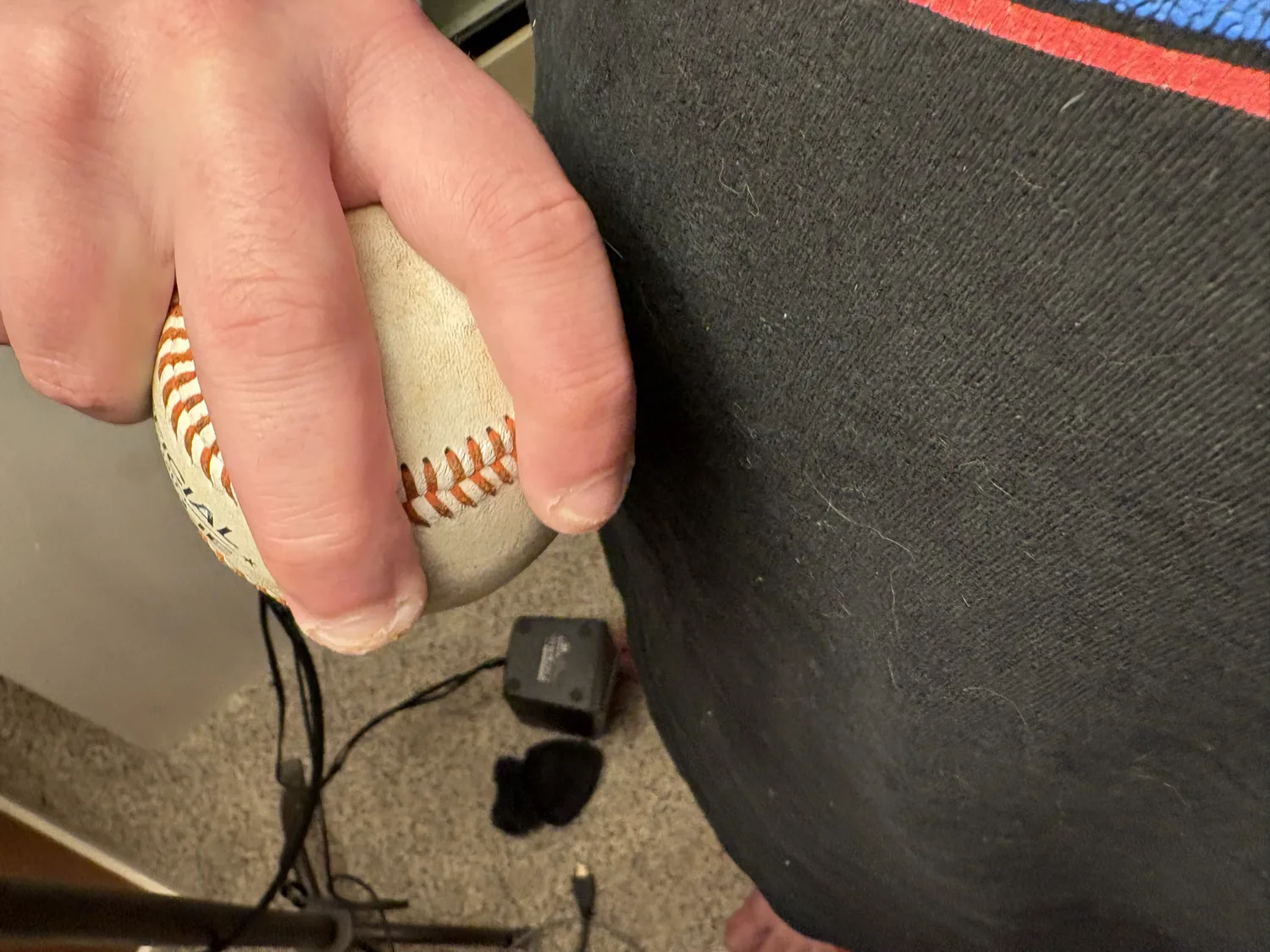 Side
SideThe same hold from the side, the fingertips just catching across the seam.
Original · Austin H. · 2026Photo-supported grip cue
Two-finger fastball family grip with the fingertips crossing the seam path instead of riding inside two parallel seams.
Pitcher's own words
Two fingers on the ball, and the four-seam should be a dead giveaway. The fingertips cross the seam slightly — the very ends of the pads catching across it, not riding parallel to it. There is barely any pressure on it at all, and that is why it leaves clean and true. It is the bread and butter of everything: the easiest pitch to place in the zone and the most consistent pitch in the game.
My best pitch, and the one I had pinpoint command of — it went straight and I could put it anywhere in the zone. The life came late: it tended to explode into the glove at the very last second. That last-second hop is the carry the four-seam is known for — the eye reads it as rising when it is really just falling less than expected.
Sourced public record
The existing official and cited claims stay in the page below with their original confidence labels. This photo does not upgrade or replace those sources.
Grip photo only; does not prove tracked speed, spin, shape, command, injury risk, or outcome.
See every grip in the Grip Library.
Release Room
Grip shape only matters if the release makes sense. Read pressure, thumb support, and ball depth before you read the pitch shape.
A little daylight stays between ball and palm so the ball leaves clean.
Primary fastball pressure
Let the index and middle pads roll the ball off the top with backspin.
Thrown over the top with the fingers behind the ball. The release rolls the ball from the fingertips with backspin so all four seams cross the oncoming air each revolution. That is the name: four seams biting the airflow per turn.
Paraphrased from the cited reference.
Movement
The read is shape, not a gauge. The spin words explain why it moves that way, and every prose claim still carries its source.
Shape
Rides
Rides through the top of the zone. Backspin fights the fall the whole way, so it drops less than a spinless ball and looks like it holds its line. It carries; it never literally rises.
Spin words
Near-horizontal backspin, the axis lying close to flat across the ball.
Craft read
Clean backspin pushes up on the ball the whole way to the plate, so it falls less than a ball thrown with no spin. The hitter swings where they expect it, and it arrives a touch higher. That is carry. It rides; it never literally rises.
The one teaching sentence
Backspin throws a Magnus force upward, but it stays smaller than the ball weight, so the pitch drops less than a spinless one. It rides. It does not rise.
Nolan Ryan on his four-seam and two-seam
Ryan in his own words on the two fastballs. The four-seam stays true and rides up on the hitter; the two-seam runs in on a righty and away from a lefty. It's the exact four/two split these specimen pages are built on, taught by the man who threw it.
“Nolan Ryan didn't just throw gas — he understood movement. His breakdown of why the 4-seam plays up, and why the 2-seam is deadly running in on a right-handed hitter / away from a lefty.”
Original post, embedded from TikTok and credited — not rehosted.
Master Files
Three arms, one pitch, three ways to win with it. The visual is our own schematic of the four-seam reference. What sets each version apart is in the read, not a gauge.
The carry-ceiling case: a clean backspin read and a top-zone finish hitters keep swinging under.
A clean carry read taken to its ceiling. His four-seam plays at the top of the zone because hitters keep swinging under the ride.
The carry case. Elite ride from a flat approach, the pitch hitters swing under.
Big ride from a low, flat slot. The ball stays on a flatter plane than the eye expects, so it finishes above where the swing is aimed — carry as a weapon at the top.
The axis-cleanup case. He raised his slot, cut the arm-side run, and converted that lost run into ride.
He raised his arm slot, traded away arm-side run, and converted it into pure ride — the same pitch, recut for carry.
The colophon
Nothing here is marked right or wrong. It is marked by where it came from and how confident the source is. A broken citation throws at build, so a dead source never reaches you.
108 double stitches, 216 individual · seam-informed schematic · as of the dates above
The arm who owned it
Others in the fastball
Tier 03 / Field Notes
Every pitcher fiddles. A thumb creeps lower, a seam catches more leather, a cue from a coach suddenly makes the pitch move. Pitch Atlas files those experiments as specimens with context, so the small discoveries stop disappearing into group chats and comment sections.
How notes rank
There is no single correct way to throw a pitch, but there are better and worse claims. A funny line should never outrank a tested grip. So notes do not rise on raw votes. They rise on weighted signals - provenance and adoption first.
Source tier and evidence. A coach-observed note with a link outranks an unverified hunch with none.
How many other pitchers independently tried the same tweak. Real replication, not passive clicks.
Marked useful, measured against views so a small loud crowd cannot stuff the rank.
How close a note is to your level, slot, and pace context. Computed in your session, never stored.
Considered practice: a real sample size behind the claim, not one good bullpen.
The vocabulary
Your bullpen card
0 ptsFiling as an unclaimed contributor · anonymous.
Throw the four-seam fastball with a wrinkle of your own? Add it. Label where it comes from: your own report, a coach, or a hunch. Keep it to grip and technique only. No medical, injury, workload, or youth-training prescriptions. Sourced, not corrected.
Keeping the bullpen honest
Field Notes are live for grip and technique only. No medical, injury, workload, or youth-training prescriptions. Every note carries a source and confidence label, and contributors can report problems. No abuse, no personal attacks, no off-topic spam, nothing aimed at minors. New field notes stay private until review. See a problem with a public note? Use Report on it; a note flagged by enough people is hidden automatically until it is checked.
Every community variant carries the same source and confidence labels as the records above. Nothing appears here unsourced, and no count is shown until it is real.