Wainwright spent his whole career with the St. Louis Cardinals, and he spent it leaning on one pitch. The curveball was big and slow and arrived at the same speed no matter how hard he threw it, and it buckled knees from his rookie September to his final start. His brother taught it to him as a kid. He threw it on top of the ball and well out in front, with a double-jointed thumb that put extra spin on the end of it, and when the biggest at-bat of his life arrived, he threw it again.
Master · 2005-2023 · right-handed
Adam Wainwright
One curveball, one team, eighteen seasons: a big, slow hook so trusted it ended a pennant on a called strike three.
Signature pitch12-6 curveball
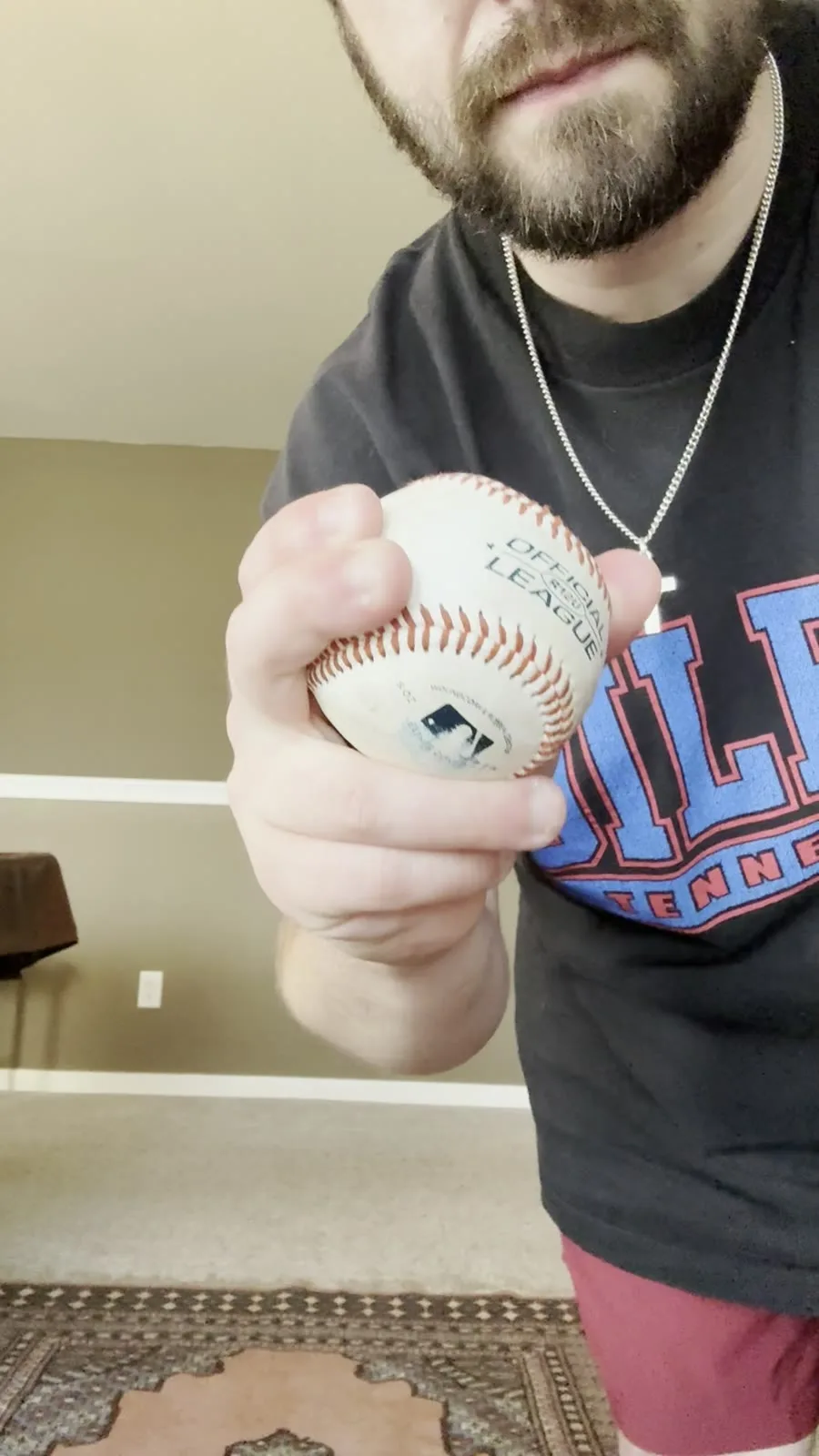
Inspect the 12-6 curve gripThe signature pitch
A big, slow curveball thrown on top of the ball and released well out in front, so it stayed hidden until it broke. His grip was a little around the seam, and he had a double-jointed thumb he could turn over at release to add spin on the end of the pitch. In his prime it was a true over-the-top 12-6; as his arm slot dropped with age it took on more side-to-side, a two-plane 2-to-7 shape.
Pitcher's own wordsFanGraphs, Nick Kingham, Mark Prior, and Adam Wainwright on Crafting Their Curveballs (David Laurila)
His own account to FanGraphs: the around-the-seam grip, the double-jointed thumb, the out-front release, and the 12-6 flattening toward 2-to-7 as he aged.
The mental edge
His edge was one pitch he trusted completely. No matter how hard he threw the curve it came out the same slow speed, the same every time, so he could throw it in any count without tipping how fast it would arrive. He was blunt about how much rested on it: without the curveball, he said, he never gets out of A-ball. Hitters knew it was coming and could not lay off; Joey Votto compared reading it to a ball dropped off a ladder, impossible to tell ball from strike.
Pitcher's own wordsESPN, The secret to Adam Wainwright's success: a curveball like none other (Buster Olney)
The "same speed however hard I throw it" and "out of A-ball" lines are Wainwright's own, via ESPN. Votto's "ladder" description is a hitter's, from the same piece.
“If I didn’t have my curveball, I don’t get out of A-ball.”
To ESPN, on how completely his career rested on the one pitch.
The record
Eighteen seasons, one uniform. He won two hundred games as a Cardinal and struck out more than two thousand hitters without ever throwing a pitch for anyone else — he and Bob Gibson are the only two arms to collect that many strikeouts entirely in St. Louis.
Official dataBaseball-Reference, Adam Wainwright
The signature at-bat came first: a rookie closing Game 7 of the 2006 NLCS, bases loaded, two outs, Carlos Beltran looking — and the curveball froze him for the pennant.
Reputable analysisWikipedia, 2006 National League Championship Series/ 2006
Fifteen years later, the two-thousandth strikeout came on the same pitch. The curve, again, in 2021.
The numbers live with the record-keepers.
The record is told here the way the rest of the atlas is told: in prose, each claim confidence-labeled and one click from its source. Where reputation and record disagree, the gap is shown, not smoothed over.