Skip to content
A looping close-up of Austin's two-seam grip: two fingers running along the narrow seams like train tracks.
Austin’s grip · in motion

Archive file · Specimen No. 01

Two-seam fastball

Almost as hard as the four-seam, but it tails toward your arm and sinks. A ground-ball pitch.

Open this like an archive drawer: grip first, source attached, shape in words, no invented spin or movement numbers. The file exists so the hold can keep moving forward.

Shape read

Holds flat · arm-side run

Hard arm-side run with late sink, finishing at the knees. It gives up the four-seam's ride and tails toward the throwing hand instead, so it appears to dive by comparison and rolls bats over into the ground. The extreme movers run on the seams, bending later than the spin alone would suggest.

ShapeOfficial data

Index and middle fingers run along the pair of narrow seams that sit close together, rather than across the horseshoe. That orientation tilts the ball away from pure backspin and trades ride for arm-side run and sink.

FastballThe runnerMagnus, tilted
GripReputable analysis

Archive Drawer / Grip Lab

The artifact in the hand

Lead with the hand. The fingers on the ball below are the sourced contacts, solved onto the seam. Drag the ball, or use the view buttons.

A Two-seam fastball held right-handed: the solved finger silhouettes drawn on the seam schematic.THUMB

View

Hand

Keyboard: arrows switch views · F flips the hand · H lifts it

  1. 01Set your index and middle fingers along the two narrow seams where they run close together, not across the horseshoe.
  2. 02Keep the same width and softness as your four-seam: a finger-width apart, held out in the hand.
  3. 03Rest your thumb underneath on the leather; some pitchers ride the side of the thumb against a seam.
  4. 04Throw it like a fastball. The grip makes the movement. You do not have to.

What it should feel like

Same effort as the four-seam. Stay behind it and let the seams do the work.

Grip geometry is schematic and shows the standard along-seam family, not every one-seam or sinker variant. In a live photo, the tell is two fingers riding paired seams like train tracks.

Ball depth

Out in the fingers

Spacing

Slight spread

The sourced grip, in full

Index and middle fingers run along the pair of narrow seams that sit close together, rather than across the horseshoe. That orientation tilts the ball away from pure backspin and trades ride for arm-side run and sink.

Paraphrased from Driveline, not quoted.

The standard Driveline two-seam grip lays the index and middle fingers on the two close seams, thumb underneath or slightly off-center, ring finger steadying the side. It is the baseline grip most arms reach for first.

Paraphrased. Driveline labels this the default two-seam family and the one most pitchers default to.

For a sinker specifically, the index finger often shifts slightly inward while keeping seam contact, biasing the release toward side-spin and diving action over balanced backspin-and-run.

Paraphrased.

The most extreme movers ride a single seam: a one-seam grip that orients the leather to bend the airflow itself, adding run and sink beyond what the spin alone would suggest. Most of the biggest seam-shifted-wake movers Driveline studied were throwing a one-seam sinker.

Paraphrased. The one-seam grip dominated Driveline's study of the largest axis-deviation pitchers.
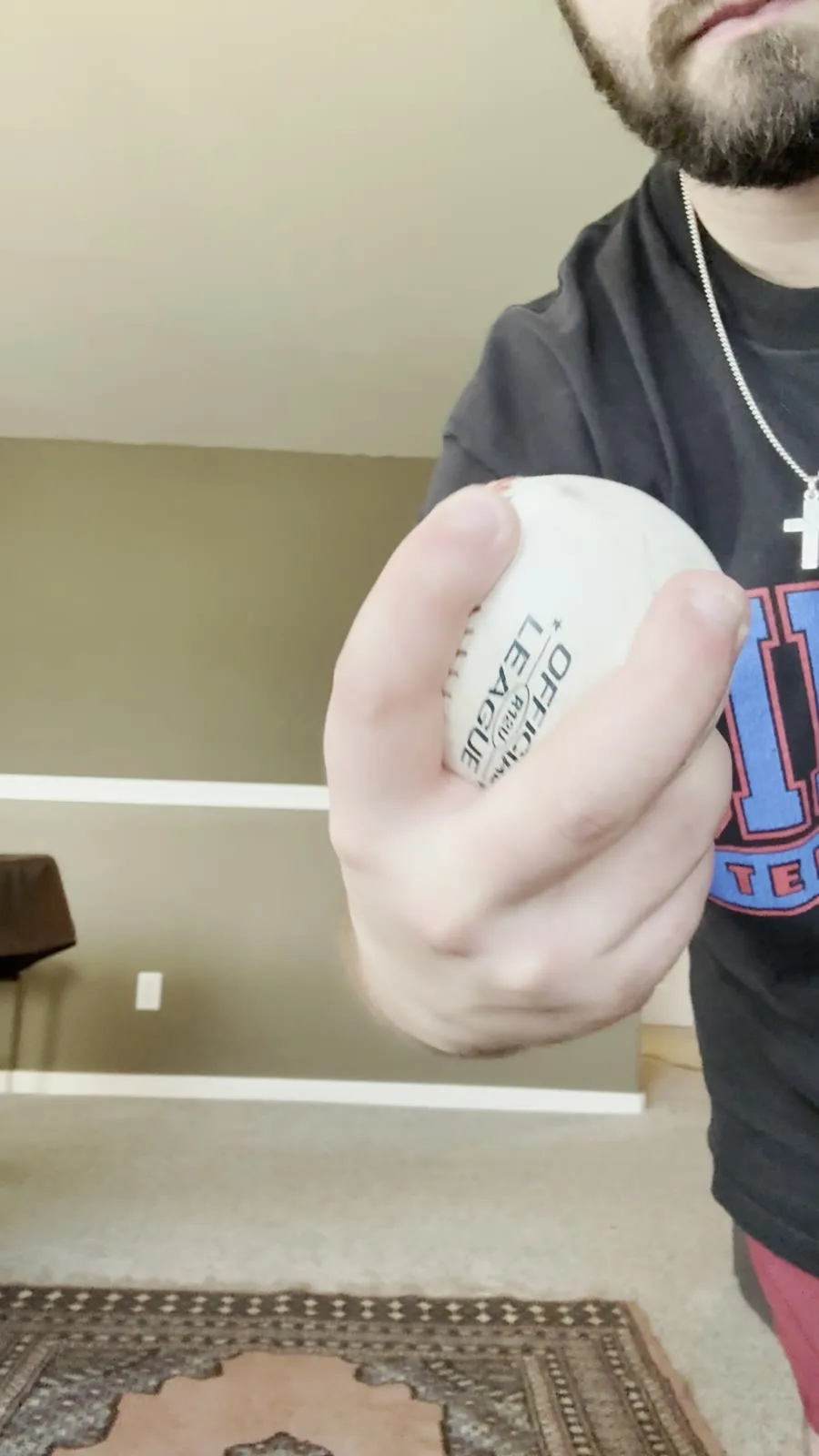
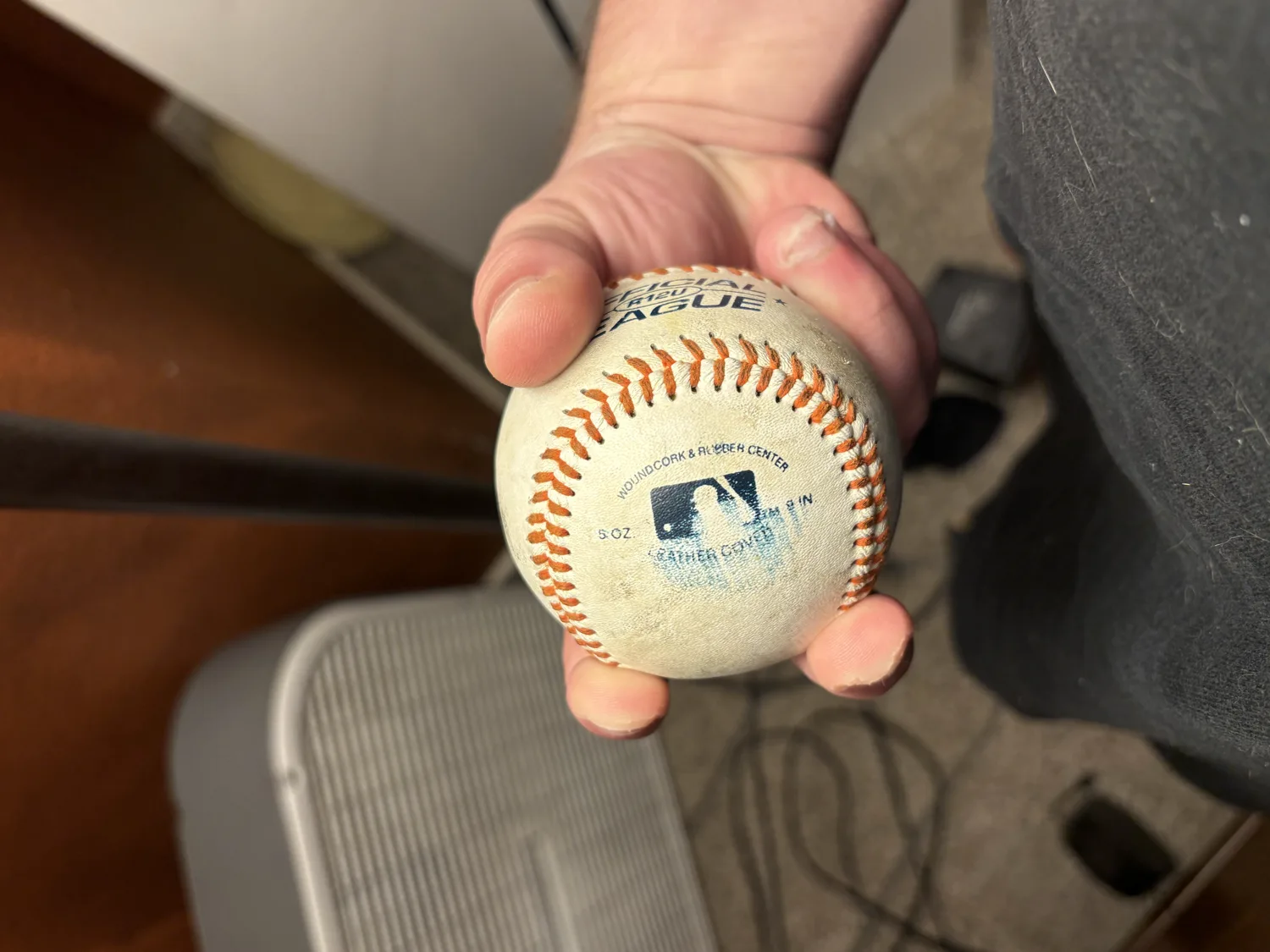
Grip Evidence

The photo can say this much

This is the visual grip-reference layer for Two-seam fastball. It names visible placement and Austin's own feel notes, then stops before making measured claims.

Motion

A looping close-up of Austin's two-seam grip: two fingers running along the narrow seams like train tracks.

Original · Austin H.
A hand gripping a baseball two-seam style, index and middle fingers running along the two narrow parallel seams.Top

Two fingers running along the narrow seams, the train-track look that names the pitch.

Original · Austin H. · 2026
A two-seam fastball grip viewed from the front, fingers resting on the parallel seams.Side

The seams as rails: the fingers sit on the two seams where they run closest together.

Original · Austin H. · 2026
The underside of a two-seam grip, the thumb supporting from below.Underside

From beneath, the thumb braced under the ball.

Original · Austin H. · 2026

Photo-supported grip cue

Two fingers are lined with the seams like train tracks, which is the visible tell Austin uses to separate it from the four-seam.

Pitcher's own words

Two fingers on the ball again, but here they line up with the seams like the ball is running down a train track — both fingers riding along the narrow seams instead of crossing them. That is the tell that separates it from the four-seam.

The second pitch I mastered. I lived with it in on the hands to right-handed hitters, because it had explosive late tail — it ran arm-side at the very last second, right in on a righty.

Pitcher's own words

Sourced public record

The existing official and cited claims stay in the page below with their original confidence labels. This photo does not upgrade or replace those sources.

Grip photo only; does not prove tracked speed, spin, shape, command, injury risk, or outcome.

See every grip in the Grip Library.

Release Room

Translate the hold into a release

Grip shape only matters if the release makes sense. Read pressure, thumb support, and ball depth before you read the pitch shape.

01

Hold

Held like a fastball: out in the fingers, not choked into the palm.

02

Pressure

Starts the arm-side bias

03

Leave

Throw fastball effort and let the along-seam contact tilt the axis.

The release rolls the fingers over the outer half of the ball, adding side-spin to the backspin and tilting the axis toward the arm. A lower slot adds more of that tilt; on one-seam grips the seam orientation adds late sink without changing the slot. The cue is a downhill plane attacked at the knees, a pitch built to be hit on the ground.

Paraphrased from Driveline; the seam-shifted-wake point is cross-referenced to the Driveline SSW article.

Movement

It rides far less than a four-seam and runs toward the arm. Thrown low, it produces ground balls.

The read is shape, not a gauge. The spin words explain why it moves that way, and every prose claim still carries its source.

Shape

Holds flat · arm-side run

Hard arm-side run with late sink, finishing at the knees. It gives up the four-seam's ride and tails toward the throwing hand instead, so it appears to dive by comparison and rolls bats over into the ground. The extreme movers run on the seams, bending later than the spin alone would suggest.

Spin words

Backspin tilted toward the throwing arm, the axis rolled off the four-seam's near-vertical toward the hand. Less of the spin lifts the ball, so it rides less and sinks. Mirror the tilt for a left-hander.

Craft read

Running along the seams tilts the spin, so the ball tails toward your throwing hand and rides far less than a four-seam, which is why it sinks by comparison. You trade a little pure life for movement that buys ground balls and weak contact.

The one teaching sentence

A four-seam rides because near-pure backspin points the Magnus force straight up. A sinker tilts that axis toward the arm and throws in less efficient spin, so the force points up and sideways instead. The ball rides less, runs toward the arm, and finishes low, which is how it turns barrels into ground balls.

See it taught · @bsf_pitchingperformance on TikTokAdded Jun 2026

Nolan Ryan on his four-seam and two-seam

Ryan in his own words on the two fastballs. The four-seam stays true and rides up on the hitter; the two-seam runs in on a righty and away from a lefty. It's the exact four/two split these specimen pages are built on, taught by the man who threw it.

Nolan Ryan didn't just throw gas — he understood movement. His breakdown of why the 4-seam plays up, and why the 2-seam is deadly running in on a right-handed hitter / away from a lefty.

Original post, embedded from TikTok and credited — not rehosted.

Master Files

Three ways the same pitch wins

Three documented sinkers: the two-seam taken to its extreme, three ways down. The visual is our own seam schematic. What sets each version apart lives in the read, not a gauge.

Framber Valdez

The textbook modern sinker as a ground-ball engine, a whole elite starter built around one arm-side-running, diving fastball thrown at the knees.

The ground-ball engine. Hard arm-side run and almost no ride leave the ball diving at the knees, and he has led the league in rolling bats over into weak contact — a whole rotation arm built around one sinker thrown low.

Logan Webb

The right-handed answer to the same idea: a sinker-first starter whose wide arm-side spread rolls bats over into weak contact.

The low-spin case taken to its end. He throws it with so little ride that it barely fights gravity at all, so it sinks hard and runs wide to the arm side — a sinker-first starter who manufactures ground balls in bulk.

Clay Holmes

The seam-shifted-wake case: a power sinker whose movement bends well past what its spin axis predicts, the clearest live example of a ball running on its seams.

The seam-shifted-wake case. His power sinker bends well past where the spin axis says it should, the ball running late on its seams — among the most deceptive sinkers in the game because the movement arrives after the eye has committed.

The colophon

Every claim, sourced

Nothing here is marked right or wrong. It is marked by where it came from and how confident the source is. A broken citation throws at build, so a dead source never reaches you.

Tier 03 / Field Notes

Field notes from the bullpen.

Every pitcher fiddles. A thumb creeps lower, a seam catches more leather, a cue from a coach suddenly makes the pitch move. Pitch Atlas files those experiments as specimens with context, so the small discoveries stop disappearing into group chats and comment sections.

How notes rank

Evidence and context, never who shouts loudest.

There is no single correct way to throw a pitch, but there are better and worse claims. A funny line should never outrank a tested grip. So notes do not rise on raw votes. They rise on weighted signals - provenance and adoption first.

  • 35%
    Provenance

    Source tier and evidence. A coach-observed note with a link outranks an unverified hunch with none.

  • 20%
    Adoption

    How many other pitchers independently tried the same tweak. Real replication, not passive clicks.

  • 20%
    Usefulness

    Marked useful, measured against views so a small loud crowd cannot stuff the rank.

  • 15%
    Context match

    How close a note is to your level, slot, and pace context. Computed in your session, never stored.

  • 10%
    Community confidence

    Considered practice: a real sample size behind the claim, not one good bullpen.

The vocabulary

Field Note
One pitcher's report on a grip variant.
Variant
A specific, named change from the canonical grip.
Tried This
A second contributor replicating the tweak.
Coach Note
A coach reporting on an arm they work with.
Source Challenge
A standing request for the evidence behind a claim.
Provenance
The source tier and evidence that set a note’s rank.
Adoption
How many others independently tried it.
Needs Evidence
A note flagged for missing support, kept visible.

Your bullpen card

0 pts

Filing as an unclaimed contributor · anonymous.

You can take part with no account. Add an email to keep your points and notes if you switch devices, never required.

Log a field note

Throw the two-seam fastball with a wrinkle of your own? Add it. Label where it comes from: your own report, a coach, or a hunch. Keep it to grip and technique only. No medical, injury, workload, or youth-training prescriptions. Sourced, not corrected.

Field notes for the two-seam fastball

Keeping the bullpen honest

Field Notes are live for grip and technique only. No medical, injury, workload, or youth-training prescriptions. Every note carries a source and confidence label, and contributors can report problems. No abuse, no personal attacks, no off-topic spam, nothing aimed at minors. New field notes stay private until review. See a problem with a public note? Use Report on it; a note flagged by enough people is hidden automatically until it is checked.

Every community variant carries the same source and confidence labels as the records above. Nothing appears here unsourced, and no count is shown until it is real.

Everything above wears its source. When you want the set again, start at the front door: the Pitch Index.

I figured if there's any way I'm going to win my 300th game by striking the guy out, I was going to do it with the pitch that won the first game for me.
Phil Niekro · Knuckleball

The archive is readable without JavaScript. Interactive grip tools, physics controls, and comparison labs need JavaScript.